
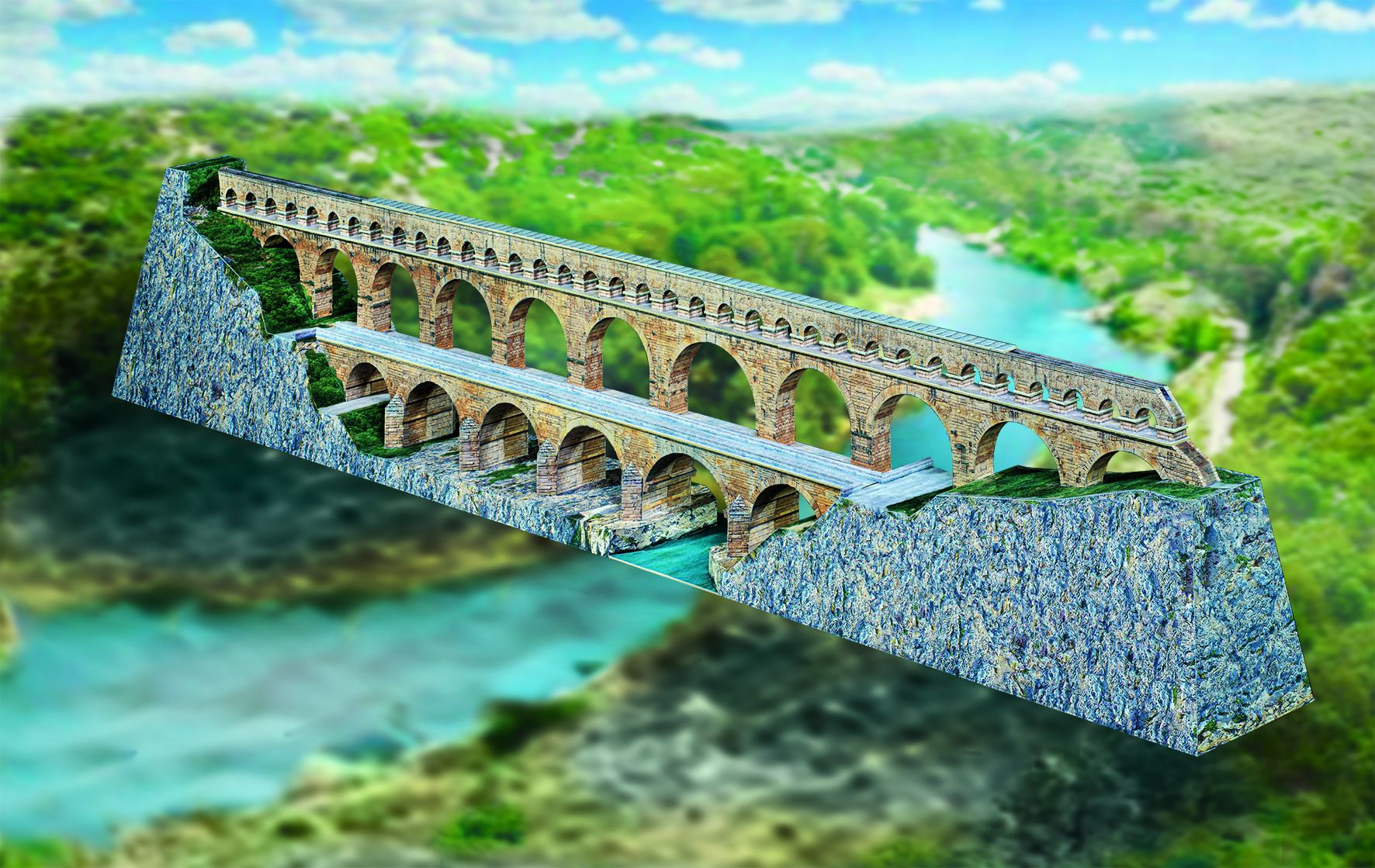
Schreiber-Bogen - Pont du Gard
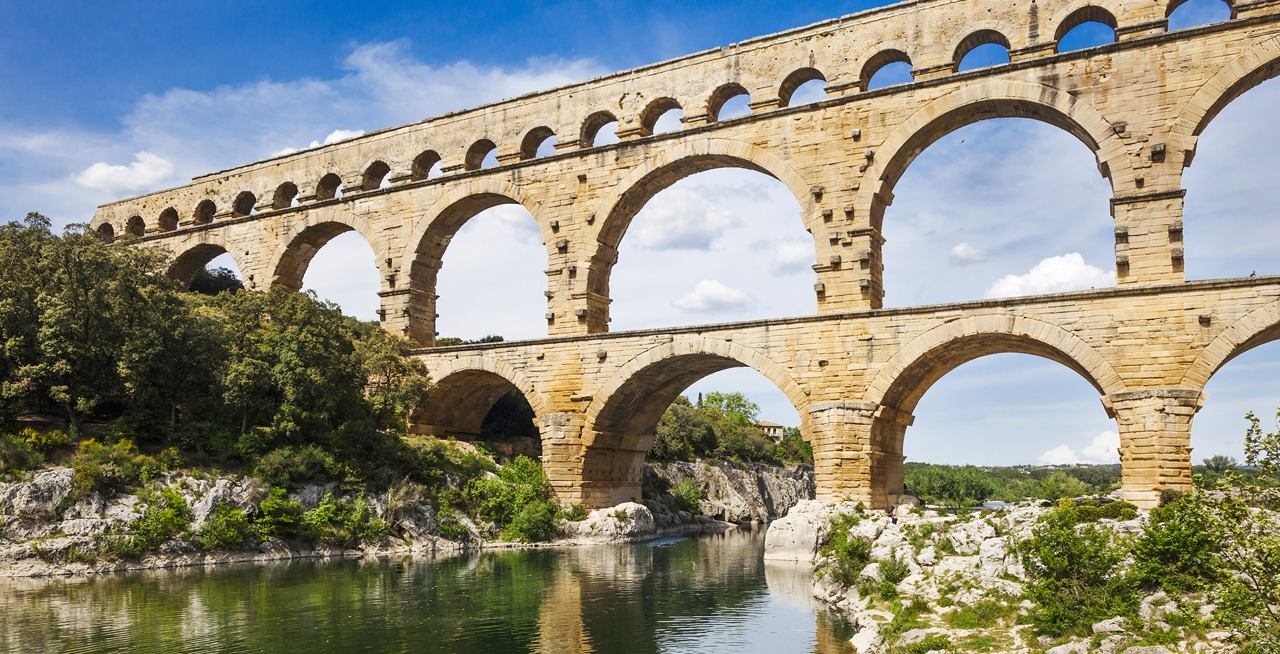
The aqueduct in southern France
is a very impressive Roman structure.It carried water across the Gardon Valley to supply the city of Nîmes.
This cardboard model allows you to build a three-tiered bridge, 1 meter in length.
Scale 1:300
13 sheets A4
Sturdy, colored paper
100 cm long, 10 cm wide, 17 cm high
Detailed design
Authentic appearance
Printed in Germany
Environmentally friendly paper
Safe for health
Distributors:
PGI-Skarabäus, Im Kränzliacker 9, 79576 Weil am Rhein, Germany, pgi-shop.de
PGI-Skarabäus, Lerchenstrasse 38, 4147 Aesch, Switzerland, pgi-shop.ch
Manufacturer: Aue-Verlag GmbH, 74215 Möckmühl, Germany
| Aspiration scale: | Medium |
|---|---|
| Time Line: | 5 Hour |
As one of the best-preserved Roman aqueducts, it is considered the most important bridge structure of antiquity and one of the most significant landmarks in southern France. The aqueduct was probably built in the 1st century AD. Construction took approximately three years and was carried out by around 1,000 slaves and prisoners of war. Rough, yellow limestone blocks of uniform size were used as the building material and fitted together without mortar. The structure was held together by the pressure of the individual stones and the resulting friction. The piers of each level were placed directly on top of the piers of the level below to reduce the load on the lower arcades. The Pont du Gard is 49 meters high and divided into three levels, which increase in length as they rise. The lower level has six arcades, and the middle level has eleven. The upper level has 35 arches and a total length of 275 meters. The entire aqueduct, stretching 50 kilometers, had a gradient of only 24 centimeters per kilometer. This allowed it to transport 20,000 cubic meters of water. The aqueduct was largely neglected in the 4th century.
By the 9th century, it was completely unusable. It was mostly dismantled by people to use the stones for other purposes. From the Middle Ages until the 18th century, the former aqueduct was used as a road bridge. Today, a visitor center is located near the aqueduct. The Pont du Gard has been a UNESCO World Heritage Site since 1985. Author: Przemyslaw Tabernacki
Adult supervision:
Children under 14 years of age should be instructed by adults on correct use to avoid risks from improper handling.
Risk of injury:
Be particularly careful when handling scissors and craft knives! Use sharp tools carefully and, if necessary, take suitable safety measures to avoid injuries.
Use of adhesive:
When using adhesive, follow the manufacturer's safety instructions. Work in well-ventilated rooms and avoid skin or eye contact.
Be careful with small parts:
Hazard of suffocation! Keep small parts out of the reach of small children.
Fire hazard:
Keep away from open fire and heat sources. Product contains highly flammable materials and can ignite or melt.
Intended use:
The material may only be used for its intended purpose. Independent modifications can impair functionality and safety.
> scissors or a cutter, e.g. craft knife
> a good all-purpose glue, e.g. craft glue
> a blunt knife for folding
> a ruler